Go Context: The Essential Guide for DevOps and Cloud Engineers
DevOps and Cloud engineers guide on golang

Advertisements
💡 Introduction: Why Context is Non-Negotiable in Cloud Go
In the world of cloud-native development, Go (Golang) is the language of choice for building fast, efficient microservices, APIs, and infrastructure tools. However, as systems become more distributed and requests bounce between services, a critical challenge emerges: how do you manage the lifecycle of a single user request across an entire system?
Imagine a request that takes 30 seconds to complete, involving calls to three different microservices and a slow database. If the user closes their browser after 5 seconds, those processes are still running, wasting CPU time, database connections, and memory. This leads to resource exhaustion, unnecessary costs, and service instability.
The solution to this problem, and the cornerstone of writing robust modern Go, is the built-in context package.
For cloud and DevOps professionals, understanding context isn't just a best practice; it's a requirement for building scalable, reliable, and cost-effective applications. It provides the standardized way to carry request-scoped data, enforce deadlines, and, most importantly, deliver cancellation signals throughout the call stack.
Context & Cancellation: The Core Concepts
The context package centers around a single interface: context.Context. This interface is passed as the very first argument to functions that might perform I/O, network calls, or any operation that could take a significant amount of time. It acts as an immutable ledger containing all the operational constraints of the request.
At its heart, cancellation is managed by two methods:
Done() <-chan struct{}: This is the cancellation signal. When the context is canceled (either manually, by a timeout, or a deadline), this channel is closed. Go's fundamental rule is that reading from a closed channel never blocks and immediately returns the zero value (struct{}), making it a high-speed, non-blocking way to signal a shutdown.Err() error: After Done() is closed, this method returns the reason for the cancellation. It will be eithercontext.Canceled(manual or parent cancellation) orcontext.DeadlineExceeded(timeout or deadline reached).
Where Do We Start? The Root Contexts
Every context tree must begin somewhere. The Go standard library provides two initial, non-cancellable “root” contexts:
context.Background(): Used as the base for the main function, initialization, or when you are absolutely certain a process should never be canceled.context.TODO(): A placeholder. Best practice dictates that you should strive to eliminate all instances ofcontext.TODO()in production code.
Context Propagation: The Parent -> Child Tree
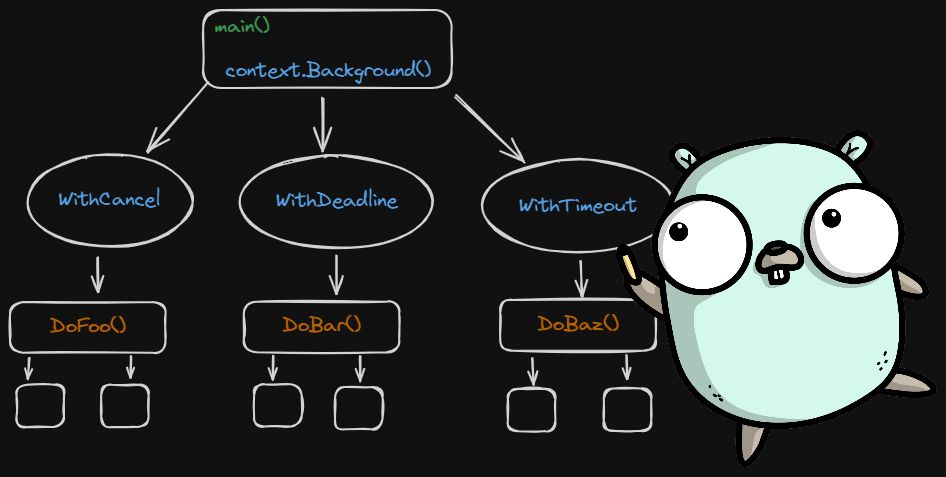
The true power of Go’s context lies in its ability to form a tree structure. You never modify an existing context; instead, you derive a new child context from a parent. This maintains immutability and allows for controlled inheritance of constraints.
The Mechanism of Derivation
You derive child contexts using a set of built-in functions:
context.WithCancelCreates a new context and a specific function to cancel just that child.
context.WithTimeoutCreates a child that automatically cancels after a duration.
context.WithDeadlineCreates a child that automatically cancels at a specific absolute time.
context.WithValueUsed to attach request-scoped values (like a Trace ID or user data).
The Critical Rule: The Cancellation Cascade
This is the rule that ensures efficient resource management across your distributed system:
A parent’s cancellation cascades down to all its children, grandchildren, and all descendants. However, a child’s cancellation never affects its parent or siblings.
If the parent (e.g., the API Gateway’s request handler) cancels, all downstream services are instantly notified to stop their work. If a child (e.g., a specific database query) fails, the rest of the request and its siblings continue running, ensuring localized failure.
How Cancellation Signals Work Internally (The select Pattern)
A function that accepts a context.Context is contractually obligated to monitor the $\text{Done()}$ channel if its internal work is non-trivial. Failing to do so results in the goroutine continuing to run even after the request has been canceled, leading to a Goroutine Leak.
The mechanism to monitor the signal is the crucial select statement:
func fetchUserData(ctx context.Context, userID string) (User, error) {
    resultCh := make(chan User, 1)

    go func() {
        defer close(resultCh)
        data, err := queryDB(ctx, userID)
        if err != nil {
            return
        }
        resultCh <- data
    }()

    select {
    case user := <-resultCh:
        return user, nil
    case <-ctx.Done():
        return User{}, ctx.Err()
    }
}
The select pattern is vital because it stops the current function execution immediately when the $\text{Done()}$ channel closes, preventing the request handler from holding onto resources while waiting for a response that will never matter.
Managing Time: WithTimeout vs WithDeadline Internals
Both functions automatically trigger cancellation, but they offer different ways of defining the time limit.
context.WithTimeout (Relative Time)
Syntax:
context.WithTimeout(parent, 5*time.Second)Mechanism: It is a convenience wrapper that internally calculates the absolute time
T deadline = T now + Duration
and then calls
context.WithDeadline.
context.WithDeadline (Absolute Time)
Syntax:
context.WithDeadline(parent, specificTime)Mechanism: Both time functions rely on the same underlying components: a dedicated goroutine that initializes a
time.Timer. When the timer expires, its channel closes, and the waiting goroutine calls the context's internalcancelfunction, which triggers the signal.
Author's Note
Chamath P.
DevOps Engineer
DevOps Engineer writing practical guides on Kubernetes, CI/CD, IaC, and SRE — based on real production experience.
This article was written with AI assistance. All technical claims and code examples have been personally verified before publishing.
Advertisements