SRE vs DevOps — What's the Difference and Why It Matters
Let's understand what SRE adds, where it came from, why Google invented it, and how the two disciplines fit together without the buzzword fog.

Advertisements
The problem that created SRE
Imagine you run a large software company. You have two teams with directly opposing goals.
The development team is measured on shipping features. The faster they ship, the better they perform. Their incentive is change new code, new deployments, new functionality, constantly.
The operations team is measured on stability. The more uptime, the better they perform. Their incentive is no change because every deployment is a risk, every new feature is something that could break, every release is a potential incident at 3am.
This conflict is not a people problem. It is a structural problem baked into how traditional software organisations are designed. Development wants to move fast. Operations wants to stay stable. Both are rational. Both are right for their respective goals. And they are fundamentally at odds.
The analogy
Think of it like a racing team where the driver wants to go flat-out and the mechanics want the car to last the whole race. The driver's performance metric is lap time. The mechanics' performance metric is the car finishing. Without a shared goal, you get either a car that never races or a driver who burns the engine. SRE is the shared goal: finish the race fast, reliably.
For decades, the software industry "solved" this by throwing the ops team over the wall whatever the dev team built and blaming ops when things broke. Then blaming dev for writing fragile code. Then hiring more people on both sides and hoping the conflict would resolve itself. It never did. Until Google tried something different.
The origin story — Google, 2003
In 2003, a Google VP named Ben Treynor Sloss was given a production operations team to run. He was a software engineer, not an operations manager. And he approached the problem like a software engineer: if operations is a problem, write software to solve it.
His insight was elegant and radical. The ops team's most soul-destroying work was repetitive, manual, undifferentiated toil rebooting servers, running deployment scripts, responding to the same alert at 3am that had fired the same way for six months. A software engineer's instinct is to automate anything repetitive. So: what if the ops team was made of software engineers whose job was to automate away the ops team's job?
"SRE is what happens when you ask a software engineer to design an operations team."
— Ben Treynor Sloss, founder of Google SRE
This founding insight has three implications that still define SRE today. First: reliability is a software problem, so engineers should solve it. Second: manual toil is a bug, not a feature if humans are doing it, it should be automated. Third: ops work should be treated with the same engineering rigour as product work with code, version control, review, and measurement.
Google published its practices in 2016 as the "SRE Book" (freely available at sre.google). It became the most influential operations document in software engineering history. Within five years, SRE roles appeared at nearly every major technology company on the planet.
Key dates: SRE invented at Google in 2003. The SRE Book published in 2016. SRE is now one of the highest-paid engineering roles in the industry precisely because it is rare to find engineers who can code well and think deeply about production reliability simultaneously.
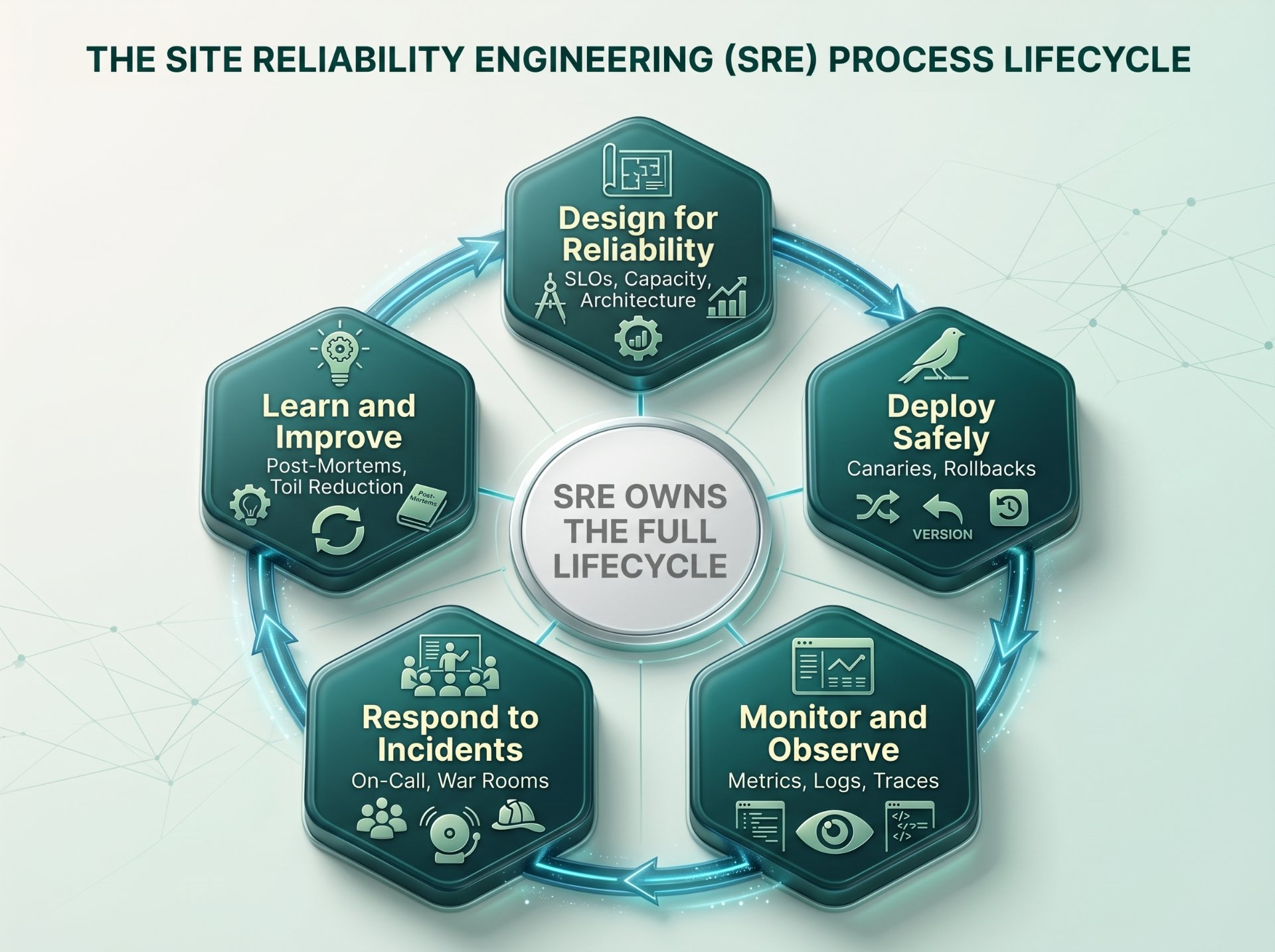
What SRE actually is
SRE : Site Reliability Engineering is a discipline that applies software engineering principles to operations problems. The goal is to create scalable and highly reliable software systems.
That definition is correct but abstract. Here is the concrete version: an SRE team is responsible for the availability, latency, performance, efficiency, change management, monitoring, emergency response, and capacity planning of their services. They own production. Not just the deployment pipeline the actual running system, its health, and its future.
What makes SRE distinctive is not the list of responsibilities — operations teams have had those for decades. What is distinctive is how SRE fulfils them: with software, with measurement, with explicit targets, and with a documented framework for deciding when to slow down and when to move fast.
The most important SRE idea
Reliability is a feature. Not a side effect of good code. Not something you hope for. Not something the ops team is responsible for while dev ships features. Reliability is an explicit, designed, measured, engineered property of the system owned jointly by everyone who touches production, with clear targets and consequences.
DevOps vs SRE — the real difference
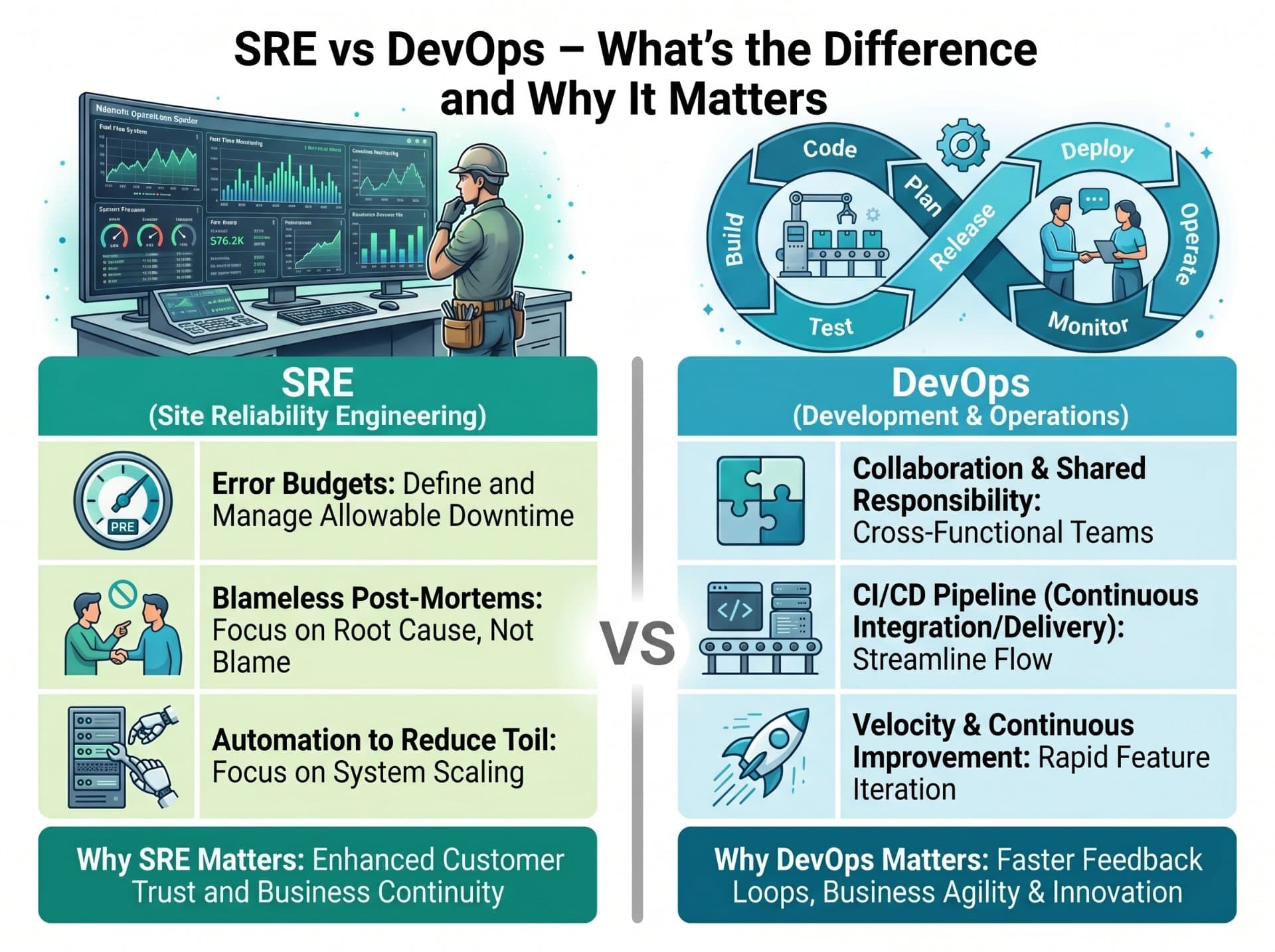
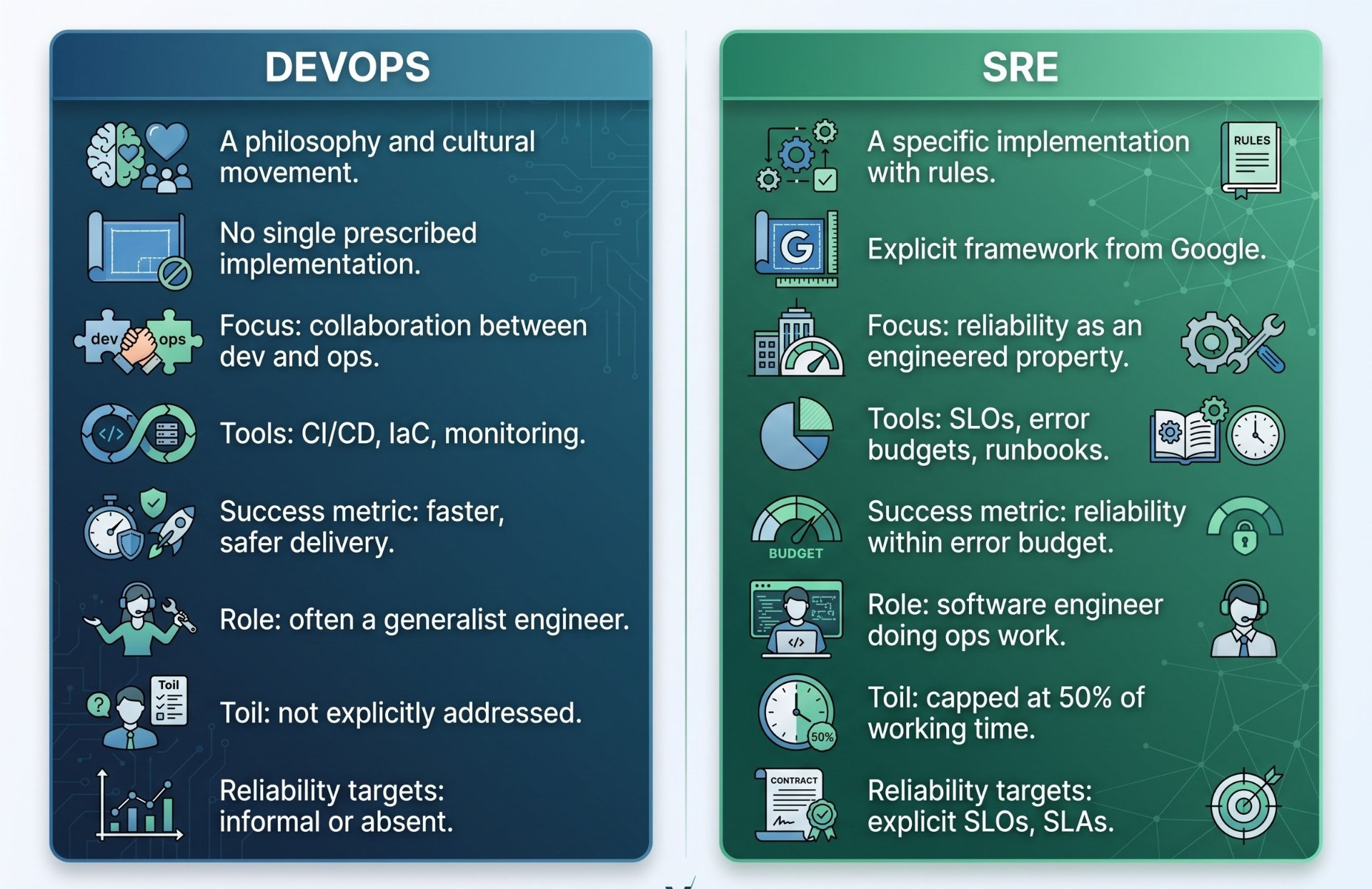
This is the question everyone asks, and it has a genuinely good answer: DevOps is a philosophy. SRE is an implementation of that philosophy.
DevOps says: break down the wall between development and operations. Share ownership. Collaborate. Automate. Measure. The DevOps movement gave us CI/CD pipelines, infrastructure as code, shared monitoring, and the cultural shift away from "throw it over the wall" releases.
SRE says: here is one specific, opinionated way to implement those principles with explicit reliability targets, error budgets, a toil limit, an on-call rotation, and software engineers doing operations work. SRE is DevOps with a rulebook.
The one-sentence version
DevOps is the "what" break the wall, collaborate, automate. SRE is one answer to the "how" here is exactly how Google does it, with specific roles, targets, budgets, and practices. Every SRE team does DevOps. Not every DevOps team does SRE.
The fundamental tension SRE resolves
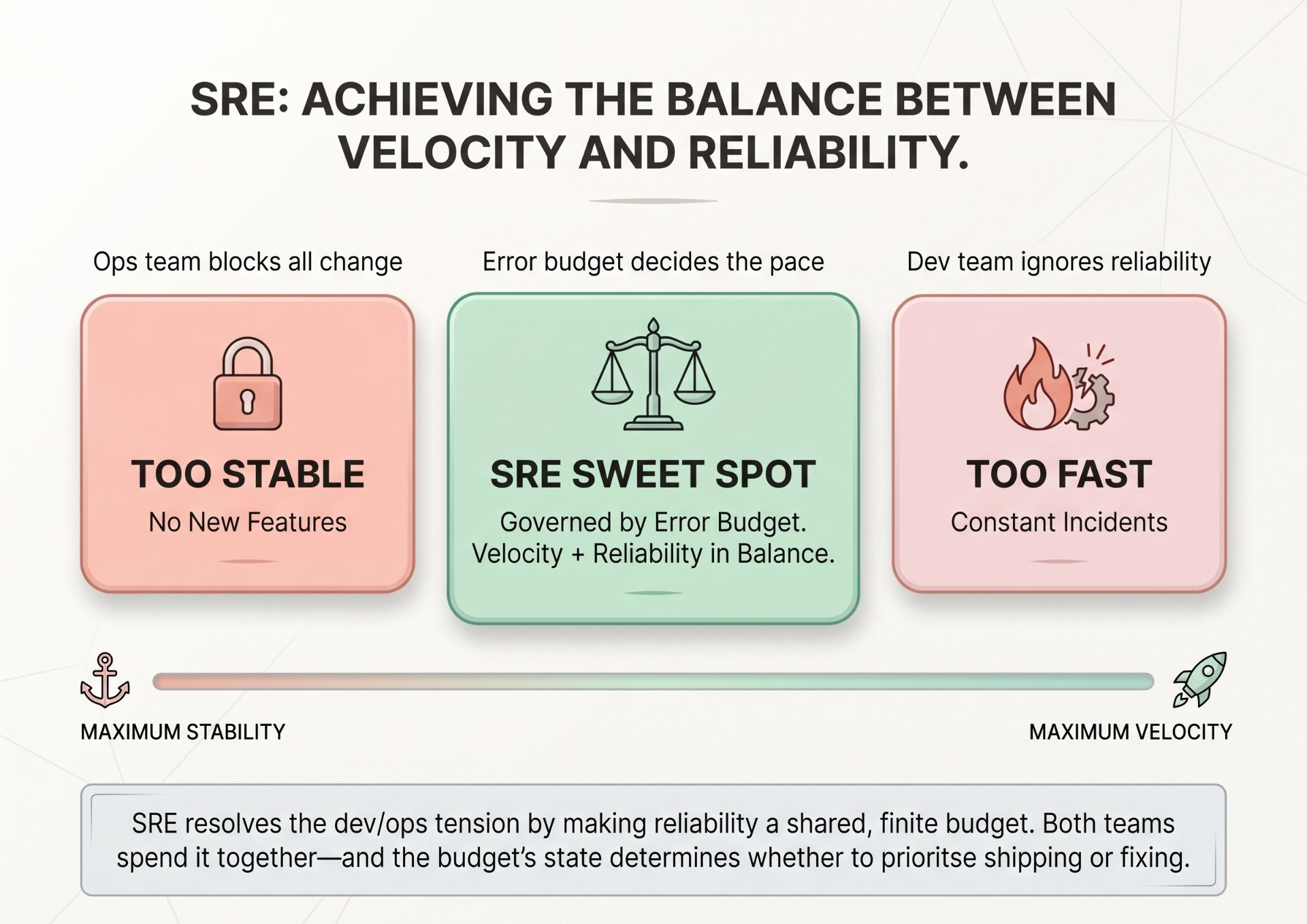
To understand SRE deeply, you need to understand the tension it was designed to resolve. It can be stated simply: development velocity and operational stability are in conflict, and you need both.
Too much stability = the product never ships new features = the business dies slowly from irrelevance.
Too much velocity = constant incidents, users leave, the product dies quickly from unreliability.
Every organisation lives somewhere on this axis. The traditional approach is to pick a point and defend it usually with the ops team acting as a gatekeeper who slows down deployments to protect stability. This creates resentment, shadow IT, and engineers who work around the gatekeepers.
SRE's resolution is brilliant in its simplicity: make reliability a finite, shared resource that both sides spend together. Give it a name error budget. Give it a number 99.9% availability means 8.7 hours of acceptable downtime per year. When the budget is healthy, spend it on velocity. When it is exhausted, stop and fix reliability. Both sides now have the same goal and the same constraint.
The error budget mindset — reliability as a resource
This is the single most important idea in SRE. It is worth spending real time on it.
Traditional thinking says: reliability is good, outages are bad, the goal is zero downtime. This sounds right but it leads to perverse outcomes. If zero outages is the goal, the safest strategy is to deploy nothing because every deployment is a risk. The ops team becomes a brake, not an accelerator.
SRE says something different: perfect reliability is actually the wrong goal. If you are running at 100% uptime, you are being too conservative. You are leaving velocity on the table. You are over-investing in reliability at the expense of feature delivery, which is also a cost.
Instead, SRE starts with a question: how reliable does this service actually need to be? For most services, 99.9% availability (three nines) is excellent. That translates to 8.7 hours of acceptable downtime per year. That 8.7 hours is the error budget the amount of unreliability you are allowed to have before the service is failing its users.
The analogy
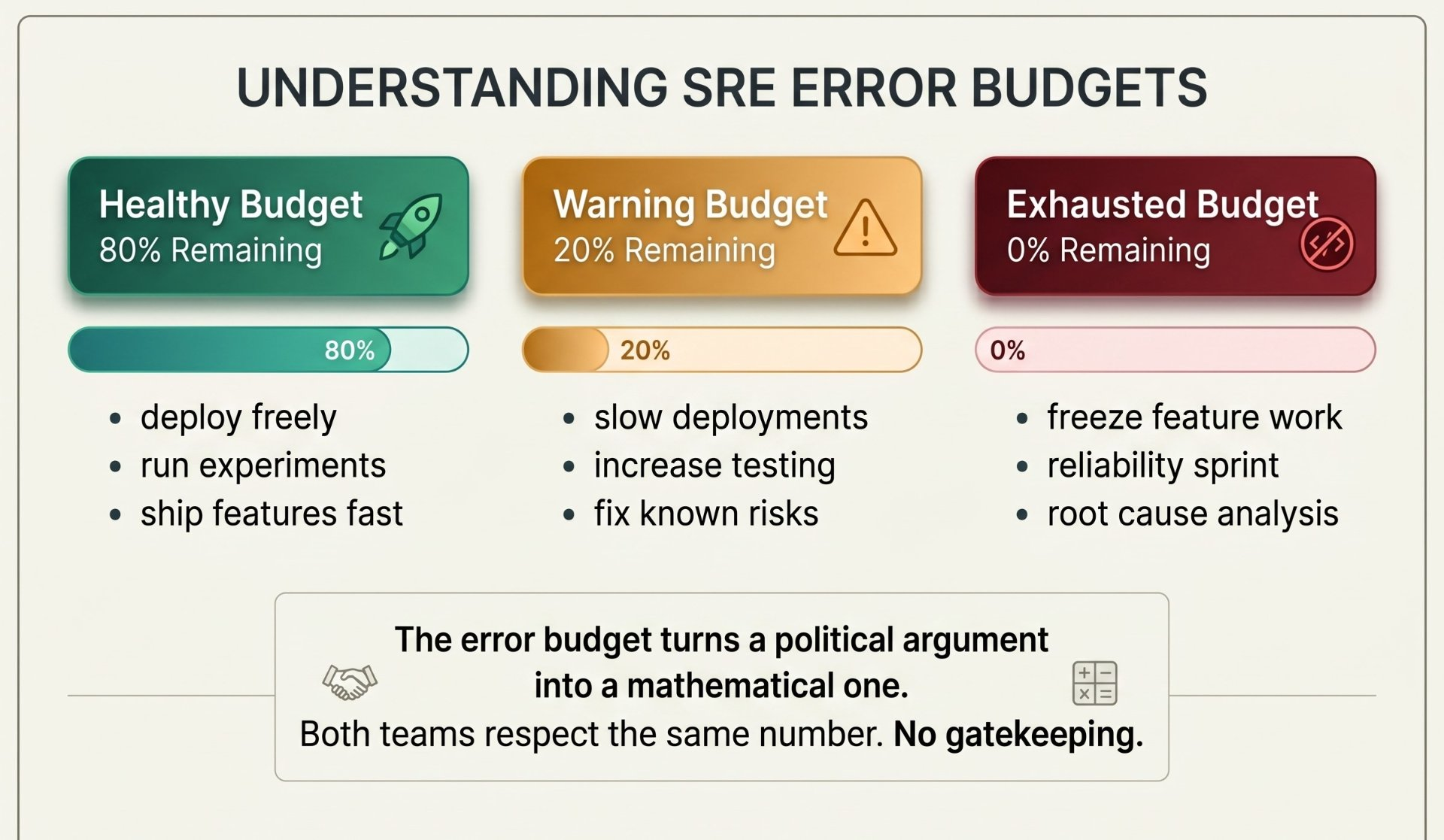
Think of the error budget like a financial budget for spending money on risk. If the budget is healthy you have plenty of downtime allowance remaining you can take risks: deploy frequently, run experiments, ship half-finished features behind flags. If the budget is nearly exhausted you have already had too many incidents this quarter you must slow down, freeze deployments, and focus on stability until the budget recovers. The budget is the governor. It is objective, shared, and impossible to argue with.
The error budget changes the conversation between dev and ops from "can we deploy?" (a subjective, political question) to "do we have error budget?" (an objective, mathematical question). This is transformative. The ops team is no longer the villain who blocks releases. The error budget is the shared constraint that both teams respect.
What SREs actually do day to day
If you come from a DevOps background, some of this will feel familiar. Some will feel new. The key difference is the intentionality everything an SRE does is in service of explicit reliability targets, not just "keep the lights on."
On a typical week, an SRE might: write code to automate a manual deployment step they noticed during their on-call rotation; review a new service's architecture for reliability risks before it reaches production; define SLOs for a new feature in collaboration with the product team; investigate an alert that fired during the week and determine whether it needs tuning or whether it represents a real problem; run a post-mortem on last week's incident and write up the action items; and contribute to a capacity planning exercise to make sure the service will handle next quarter's traffic.
The 50% toil rule
Google's SRE book mandates that SREs spend no more than 50% of their time on operational toil reactive work, manual processes, on-call incidents. The other 50% must be spent on engineering work that eliminates toil: automation, tooling, improving the system's reliability. If toil exceeds 50%, the team escalates to management. This rule prevents the SRE team from being overwhelmed by firefighting and becoming just another ops team with a fancier title.
Do you need SRE?
Honest answer: not every organisation does. SRE adds overhead explicit SLOs, on-call rotations, post-mortem processes, error budgets. For a ten-person startup, this overhead may not be worth it. For a hundred-person company with multiple production services that millions of people depend on, it almost certainly is.
The clearest signal that you need SRE practices: you have recurring incidents that consume engineering time, you cannot answer the question "how reliable is our service?", your deployments frequently break production, and your operations team is overwhelmed with toil while your dev team ships features without thinking about reliability.
If you DevOps engineer reading this, you are already practising some SRE principles. You automate deployments. You monitor systems. You respond to incidents. What SRE adds is the framework: explicit targets, shared ownership of reliability, a mathematical constraint on how much risk you can take, and the engineering discipline to reduce operational work over time rather than just manage it forever.
The most common mistake
Hiring "SREs" and giving them the same role as the old ops team just with a new title. SRE is not a job title. It is a practice. The title without the practice changes nothing. The practice without the title changes everything. Start with the practices: define your SLOs, measure your error budget, cap your toil, run blameless post-mortems. The organisational structure follows from the practice, not the other way around.
Author's Note
Chamath P.
DevOps Engineer
DevOps Engineer writing practical guides on Kubernetes, CI/CD, IaC, and SRE — based on real production experience.
This article was written with AI assistance. All technical claims and code examples have been personally verified before publishing.
Advertisements