The SRE Hierarchy of Reliability
There is a correct order to building reliability. Skip a level and you will be fighting fires forever. This article explains the six-level hierarchy, why the sequence is not optional, and how to assess where your team sits right now.

Advertisements
Why the order matters more than the destination
One of the most common mistakes teams make when adopting SRE is jumping to the flashy parts writing SLOs, building dashboards, implementing chaos engineering before they have the foundations in place. This is like building the fifth floor of a house before completing the first.
The result is predictable: SLOs without monitoring are fiction. Post-mortems without incident response are academic exercises. Automation without understanding what to automate creates fragile systems that break in new ways. The practices are not independently valuable they are a stack, and the stack has a load-bearing order.
The building analogy
Maslow's hierarchy of needs says you cannot focus on self-actualisation when you are starving. A person without food, shelter, and safety cannot meaningfully pursue love, belonging, and meaning those needs require the lower levels to be met first. The SRE hierarchy works the same way: you cannot have meaningful SLOs if your monitoring is broken, just as you cannot self-actualise while starving. Each level is the prerequisite for the one above it.
The key insight: reliability practices are not a menu you pick from they are a sequence you build through. Every level in the hierarchy depends on the levels below it being stable. Assess your current level honestly, shore up the foundations, and then and only then reach for the next level up.
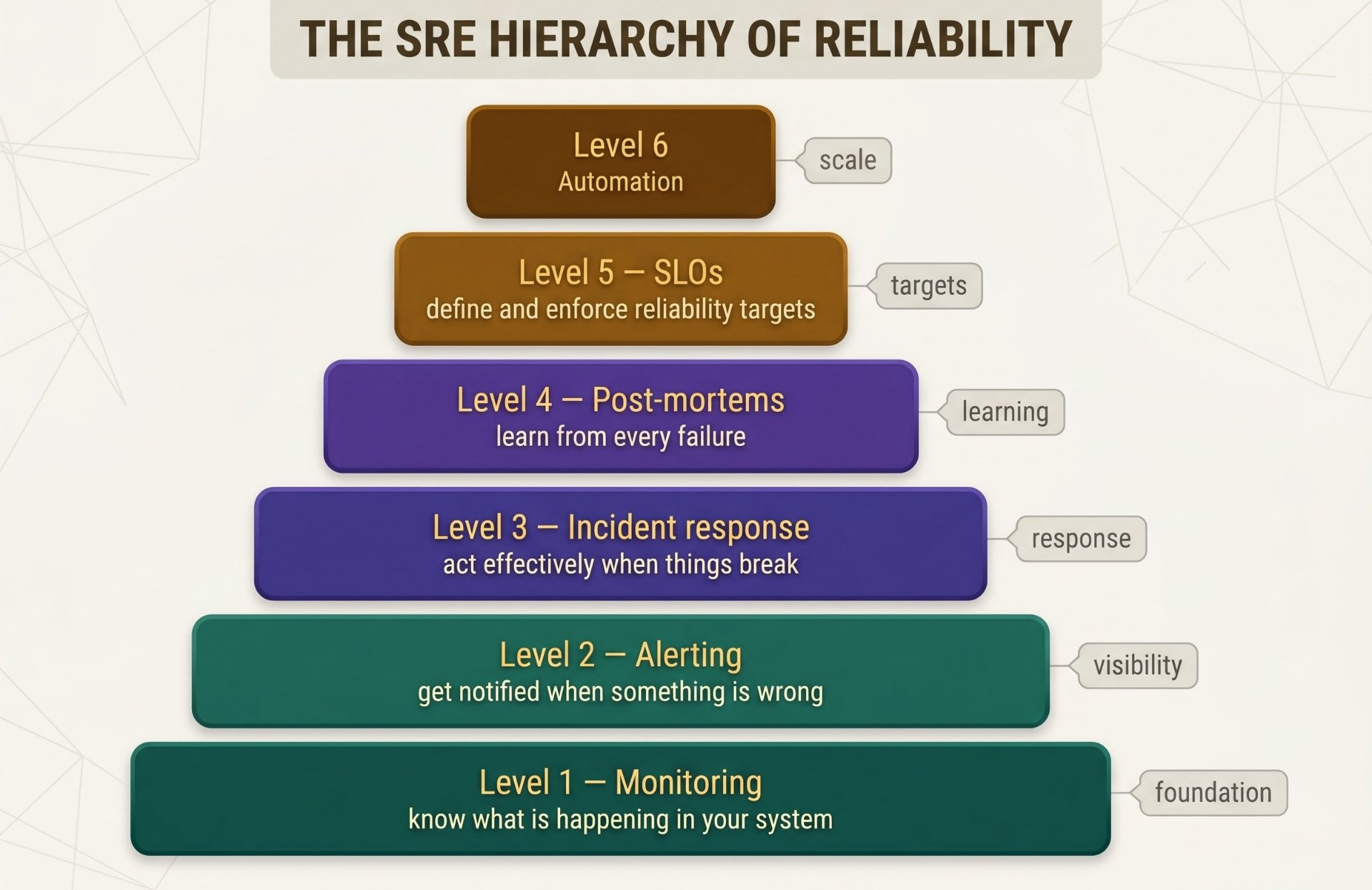
The six levels — a visual overview
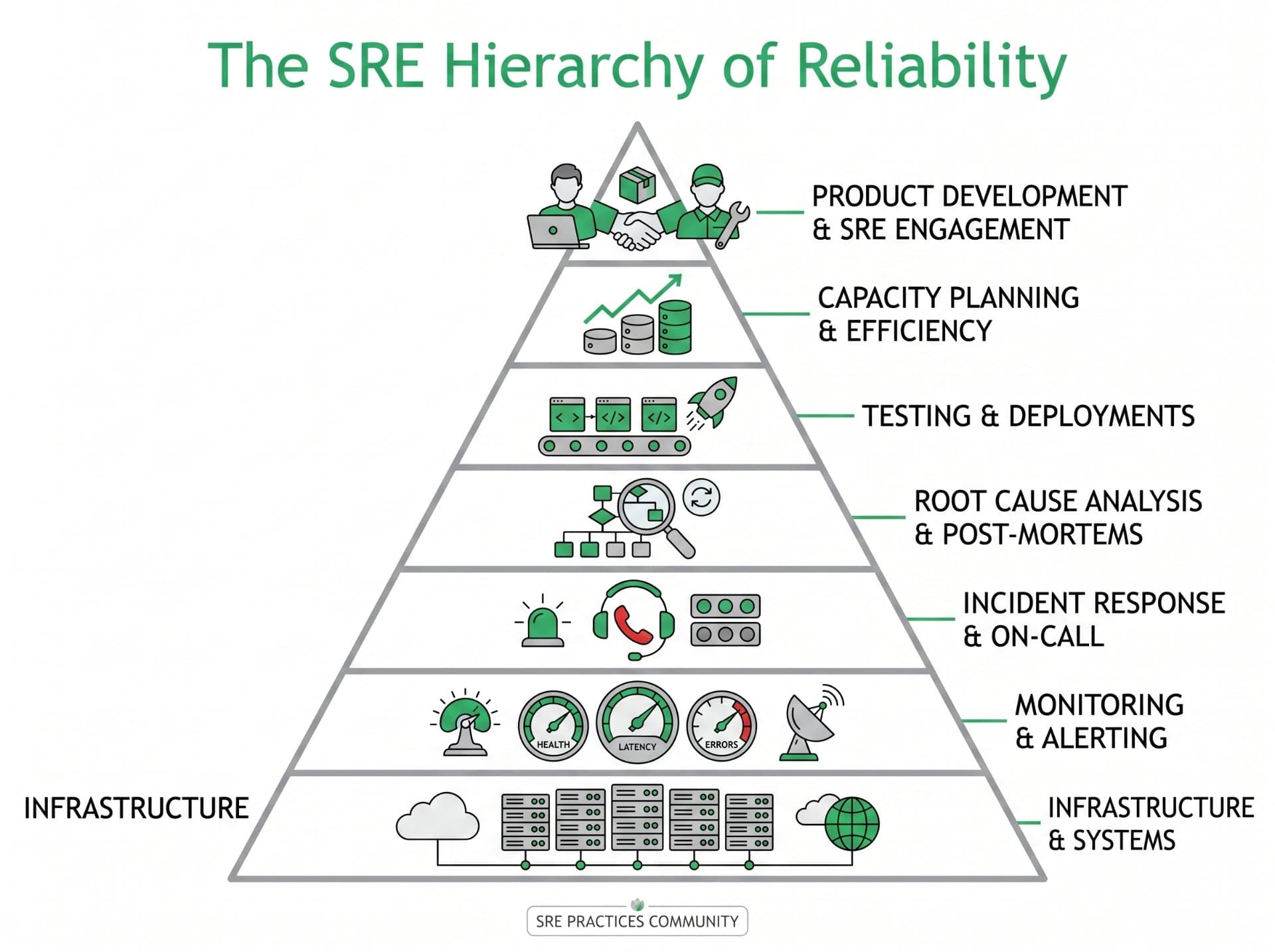
The hierarchy is a pyramid. The widest, most fundamental level is at the bottom. The most sophisticated and most fragile without the layers beneath is at the top. Every level is the prerequisite for the one above it.
Monitoring — knowing what is happening
Level 1: Monitoring - The absolute foundation — you cannot fix what you cannot see
Monitoring is the practice of collecting and storing data about your system's behaviour over time. Metrics (numbers), logs (events), and traces (request paths) are the three pillars. Without monitoring, your system is a black box you learn about problems only when users tell you, which is always too late.
Signs you are at Level 1: you have basic metrics collection but it is inconsistent across services, your logs are difficult to search, you have no idea about your service's normal baseline behaviour.
What Level 1 well looks like: every service emits the four golden signals (latency, traffic, errors, saturation), logs are structured and queryable, you have dashboards that show system state at a glance, and you know what "normal" looks like.
Monitoring is not about dashboards dashboards are just the human-readable layer on top. Monitoring is about having the data. A well-monitored system can answer questions you have not thought to ask yet, because the data is there waiting. A poorly monitored system can only answer the questions you thought to set up in advance which is never enough when something novel goes wrong.
The four golden signals
Google's SRE Book defines four golden signals that every service should measure: Latency: how long requests take. Traffic: how much demand the system is handling. Errors: the rate of failed requests. Saturation: how "full" the service is (CPU%, memory%, queue depth). These four, measured consistently across every service, form the baseline that everything else is built on.
Alerting — being notified when it matters
Level 2: Alerting - Turning monitoring data into actionable notifications
Alerting is the layer that converts monitoring data into human attention, a page, a Slack message, an email. Good alerting is much harder than most teams expect. The failure mode in both directions is severe: too many alerts causes alert fatigue, where engineers start ignoring pages. Too few alerts means problems surface too late. The goal is alerts that are always urgent, always actionable, and almost always correct.
Signs you are at Level 2: your alerting fires too often (false positives are routine), your on-call engineer acknowledges and silences alerts without investigating, alerts fire on causes rather than symptoms, alerts do not tell the responder what to do.
What Level 2 well looks like: every alert is urgent, every alert is actionable, false positives are rare, alerts are symptom-based not cause-based, each alert links to a runbook.
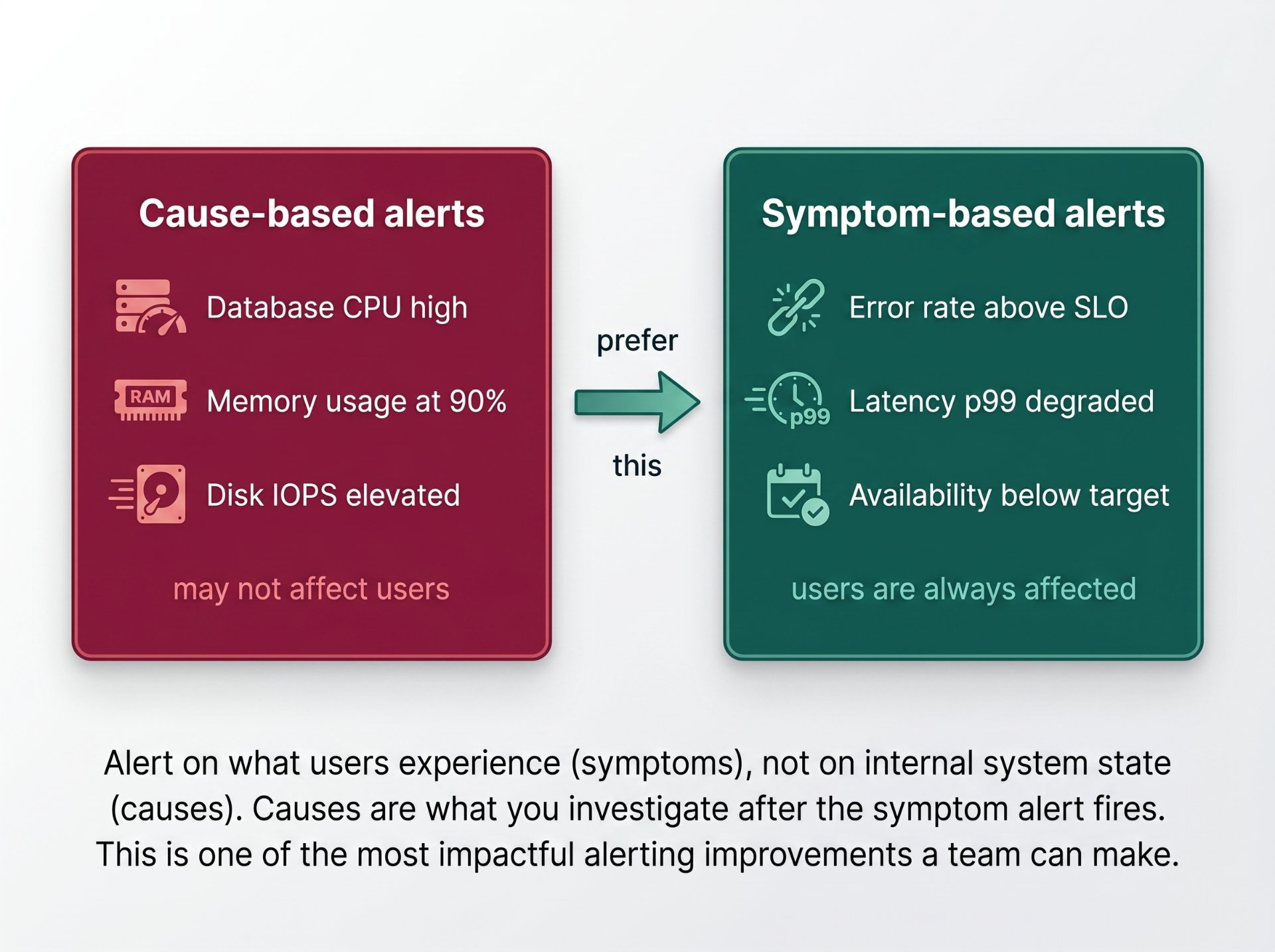
The single most important principle in alerting: alert on symptoms, not causes. A symptom is "users are experiencing high error rates." A cause is "the database CPU is high." You may not know which cause is producing which symptom, and there may be multiple causes. But users always experience symptoms, so symptoms are what you alert on. Causes are what you investigate after the alert fires.
Incident response — acting effectively under pressure
Level 3: Incident response - A structured process for when things go wrong
An incident is any event that disrupts service to users. Incident response is the structured process for detecting, coordinating, resolving, and communicating about those events. Without a defined process, incidents are chaotic multiple people making conflicting changes, no clear communication to stakeholders, no record of what was tried. A good incident response process transforms a chaotic fire into a managed recovery.
Signs you are at Level 3: incidents are chaotic, there is no clear incident commander, stakeholders are updated inconsistently or not at all, the same person who is debugging is also writing updates, rollbacks and mitigations are not documented in real time.
What Level 3 well looks like: clear severity levels, a defined incident commander role, consistent stakeholder communication, real-time incident timeline, defined escalation paths, a known mitigation-before-investigation principle.
The most important incident response principle for beginners: mitigate first, investigate second. The goal during an active incident is to restore service to users, not to understand the root cause. Root cause analysis is a post-incident activity. During the incident, the question is always "what is the fastest path to restoring service?" not "why did this happen?"
The most common incident response failure
The same person who is debugging the system is also writing stakeholder updates, fielding questions from colleagues, and trying to coordinate with the team. This is a recipe for slower resolution and worse communication. The incident commander role exists precisely to separate these concerns: one person drives resolution, one person handles communication, one person maintains the timeline. In small teams, these roles collapse but the principle still applies: do not let debugging be interrupted by communication tasks.
Post-mortems — turning failures into knowledge
Level 4: Post-mortems - Blameless analysis of what happened and why
A post-mortem is a written record of an incident, what happened, why it happened, how it was detected, how it was resolved, and what actions will prevent recurrence. The word "blameless" is essential: post-mortems that blame individuals teach people to hide mistakes and become defensive. Blameless post-mortems assume that intelligent, well-motivated engineers made reasonable decisions with the information they had and ask what changes to the system would prevent the same failure in the future.
Signs you are at Level 4: post-mortems are optional or inconsistent, they focus on what people did wrong rather than what the system allowed, action items are vague or never completed, post-mortems are filed and forgotten.
What Level 4 well looks like: post-mortems are required for every significant incident, they are blameless in both policy and tone, action items are specific and assigned, they feed back into the product backlog.
The aviation analogy
Commercial aviation has one of the strongest safety records of any human activity not because pilots never make mistakes, but because the industry treats every incident as data about the system rather than evidence of individual failure. Pilots file incident reports without fear of punishment. Near-misses are analysed as carefully as crashes. Design changes follow data. This blameless, systems-thinking culture is exactly what SRE post-mortems aim to replicate in software engineering.
SLOs and error budgets — defining and enforcing targets
Level 5: SLOs and error budgets - Explicit reliability targets with financial-grade enforcement
Service Level Objectives (SLOs) are explicit reliability targets "99.9% of requests will complete in under 200ms" agreed between the SRE team and the product team. The error budget is the flip side: the amount of unreliability you are allowed. SLOs turn reliability from a vague aspiration into a measurable, enforceable engineering property. But they only work if Levels 1–4 are solid: you cannot measure SLOs without monitoring, you cannot alert on SLO burns without alerting infrastructure, you cannot explain SLO misses without incident response and post-mortems.
Signs you are at Level 5: SLOs are defined but not enforced, error budgets exist on paper but do not change team behaviour, SLOs are not connected to deployment decisions.
What Level 5 well looks like: SLOs drive deployment decisions, error budget state is visible to everyone, product and engineering teams jointly own the budget, an exhausted budget triggers a reliability sprint.
SLOs are covered in full depth in Article 3. For now, understand their place in the hierarchy: they are the goal that all the lower levels serve. Monitoring tells you your SLO state. Alerts fire when your SLO is burning. Incident response restores the SLO. Post-mortems prevent future SLO burns. The whole hierarchy is in service of this level.
Automation and toil reduction — scaling reliability
Level 6: Automation and toil reduction - Eliminating repetitive work so humans can focus on novel problems
Toil is any manual, repetitive, automatable operational work that scales with the volume of your systems rather than the complexity of the problems you solve. Toil is not inherently bad — some is unavoidable. But uncapped toil grows with the system, eventually consuming all engineering time and leaving nothing for improvement. Automation is the SRE's primary tool for reducing toil: auto-remediation of known failure modes, self-healing infrastructure, automated capacity scaling, and runbooks that execute themselves.
Signs you are at Level 6: the same runbook steps are executed manually every week, known failure modes require human intervention every time they occur, scaling happens by manual ticket rather than automatically.
What Level 6 well looks like: known failure modes trigger automated remediation, capacity scales automatically, toil is measured and tracked, the SRE team's time is primarily spent on engineering rather than operations.
Why automation comes last, not first
Teams often reach for automation too early automating processes they do not fully understand yet, enshrining incorrect procedures in code, creating systems that auto-remediate in ways that make incidents worse. The reason automation comes at the top of the hierarchy is that you must first understand your system through monitoring, experience its failures through incidents, learn from those failures through post-mortems, and agree on its reliability targets through SLOs before you know what is worth automating and how.
Assessing where your team sits today
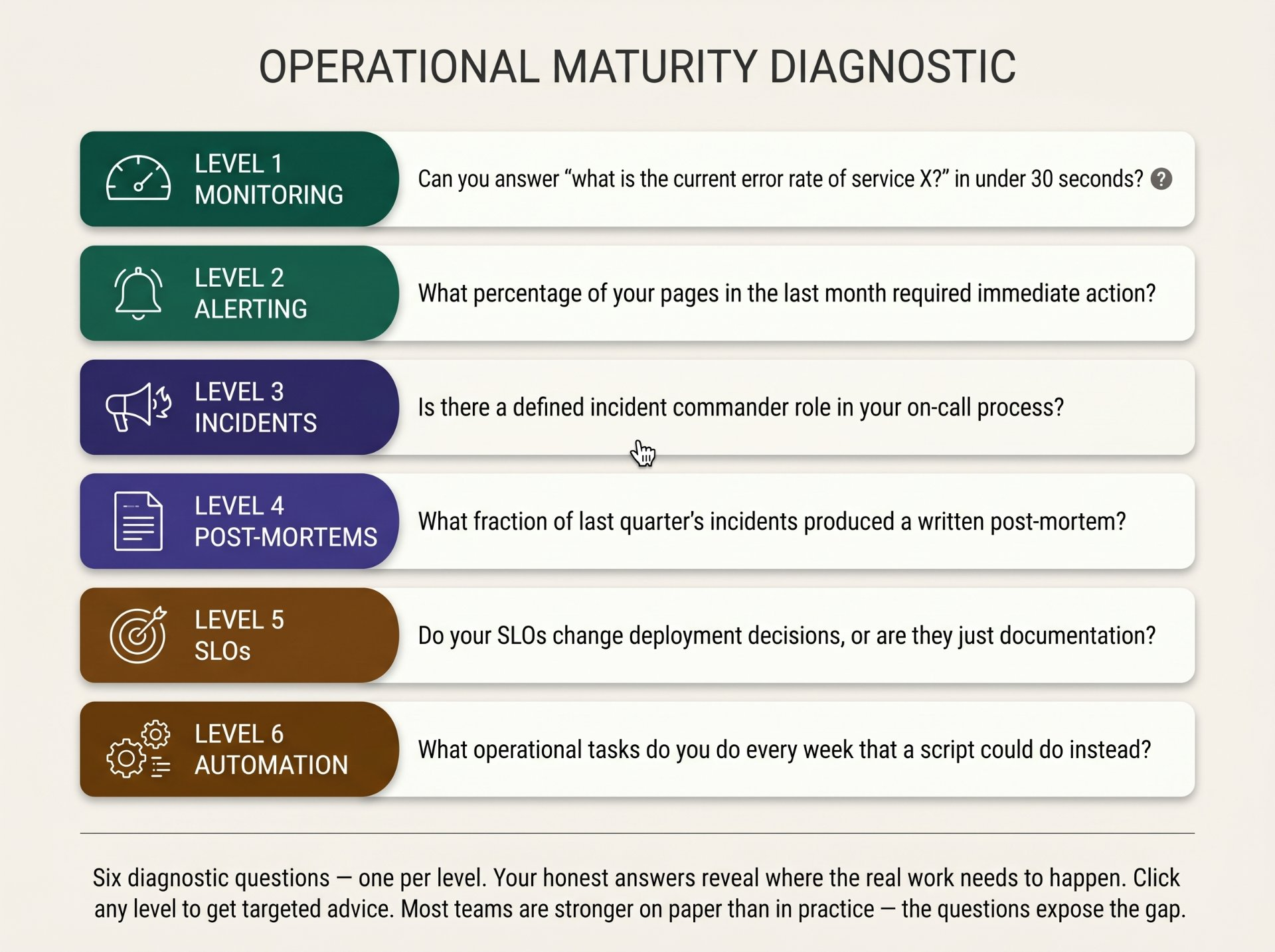
Before reading further in this series, take 15 minutes and honestly assess which level your team has solidly built. Not "we have some monitoring" but "our monitoring is comprehensive, consistent, and we trust it." Not "we do post-mortems sometimes" but "every significant incident produces a blameless post-mortem with tracked action items within 48 hours."
The most common finding
Most DevOps engineers assess themselves at Level 3 or 4, then discover through these questions that their Level 1 and 2 foundations are weaker than they thought. Monitoring is inconsistent across services. Alerts fire too often and engineers have started treating the on-call rotation as noise. This is exactly the right moment to stop adding new practices and shore up the foundation because every level above Level 2 depends on trustworthy monitoring and alerting.
Author's Note
Chamath P.
DevOps Engineer
DevOps Engineer writing practical guides on Kubernetes, CI/CD, IaC, and SRE — based on real production experience.
This article was written with AI assistance. All technical claims and code examples have been personally verified before publishing.
Advertisements